
My most recent work
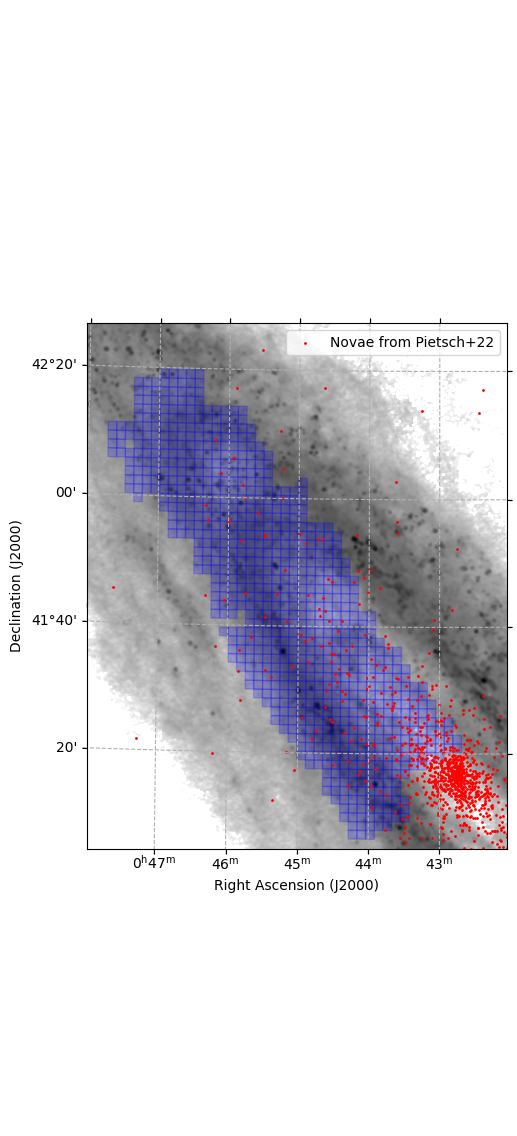
As a field test of my DTD recovery method, which applies dynamic nested sampling to a likelihood function that takes uncertainty on the SFH directly into account, I measured the DTD of classical novae in the Andromeda galaxy.
A nova is a bright transient caused by a thermonuclear explosion on the surface of a white dwarf (WD). Of course, the only way to get enough material onto a WD is for a companion star to dump it there! Therefore, novae are a probe of binary stellar evolution.
Despite being limited by a sample encompassing only half of Andromeda's surface area, and the limited research into theoretical nova DTDs, we recovered robust detections in two time bins and an encouraging match to theory. Another interesting (slightly worrying?) result was the statistically significant differences in DTDs based on the models of stellar evolution (MIST, Padova, PARSEC, BaSTI) used to calculate the SFHs.